
What Is a Buffered Life?
A Buffered Life is a life with emotional bandwidth — enough inner room between you and the demands of your life to think clearly, choose steadily, and move with intention.
It’s the foundation that makes your days feel manageable, meaningful, and genuinely yours to shape.
What Emotional Bandwidth Really Means
Emotional bandwidth is the inner space that keeps life’s demands from collapsing on top of each other.
It’s what allows you to think clearly, choose steadily, and respond instead of react.
You notice it most in your day-to-day mental world.
When you don’t have emotional bandwidth, you might:
- get stuck in thought loops
- replay conversations long after they’ve ended
- overthink even small decisions
- carry what other people expect or feel
- worry about how you’re being perceived
- feel mentally scattered or overstimulated
- lose your own wants under everyone else’s needs
These aren’t flaws.
They’re signs you’re operating at emotional capacity — without any room to breathe.
When you do have emotional bandwidth, you can:
- organize your thoughts instead of spiraling
- make decisions and move forward
- carry responsibilities without feeling crushed
- protect your energy instead of absorbing everything around you
- hear your own wants clearly enough to act on them
This is the heart of a Buffered Life.
It begins with enough inner room to function as yourself — not a version of you stretched thin by constant pressure.
A Buffered Life isn’t defined by how much you do.
It’s defined by the margin you have to move through life.
When you have emotional bandwidth, three things start to shift.
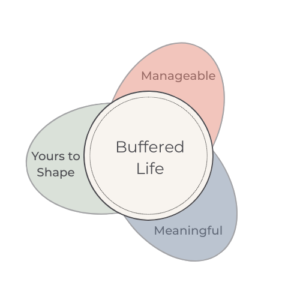
1. Manageable
Life no longer feels like a blur of obligations.
Your days follow a rhythm you can actually keep, and you move through responsibilities without feeling stretched to the edge.
2. Meaningful
Your energy supports what matters — not the noise, not the pressure, and not the constant urgency that pulls you off track.
There’s room for purpose again, even in small ways.
3. Yours to Shape
You make decisions from intention instead of reaction.
You can adjust, pause, or redirect without guilt because you’re no longer operating at emotional capacity.
You notice it most in your day-to-day mental world.
You wake up already behind.
Your day moves faster than you do.
You rush, juggle, react — and still feel like the things that matter most never get the time or attention they deserve.
You’re doing everything you can,
yet it feels like you’re not giving enough anywhere:
not enough at home,
not enough at work,
not enough to yourself.
And somewhere under the rushing and doing, a quieter fear starts to surface:
“Is this it?”
“Is this just how life is going to be?”
“Will I ever get the life I keep imagining?”
“What if I never have the room or energy for the things that matter to me?”
People don’t think this way because they’re unmotivated or lacking discipline.
They come from living a life with no buffer built into it — no room to think clearly or move toward what matters.
Here’s why it builds up:
1. Constant Mental Load
Your mind holds everything — tasks, reminders, concerns, expectations — all day.
Even simple things feel heavy when your thoughts never get a break.
2. Emotional Overload
You absorb reactions, needs, and tension from every direction.
You’re responsible for more than anyone sees, and it wears on you.
3. Decision Fatigue
Choices that used to be easy now feel draining.
You second-guess, delay, or push through because you’re tired, not because you’re unsure.
4. Reactive Days
Life pulls you from one thing to the next.
You’re responding more than choosing — surviving the day rather than shaping it.
5. Digital and Social Noise
Your attention is pulled before the day even starts.
Your mind is crowded before the morning is fully awake.
A full life isn’t the problem.
The problem is the lack of buffer inside it — the space you need to think, breathe, choose, and move toward what matters.
A Buffered Life restores that room.
When you have even a little space inside your life, things start to feel different quickly.
Not perfect. Not fixed. Just lighter and more possible than before.
Here’s what people usually notice first:
1. Immediate Relief (Day 1–3)
- Your mind feels less crowded.
- You stop rushing in your head, even if the day is still full.
- Decisions feel simpler because you’re not choosing from overload.
- You finally exhale — the kind of breath you didn’t realize you were holding.
It’s not a big transformation.
It’s a small shift that gives you your footing back.
2. Early Momentum (First Week)
As emotional space grows, small things get easier:
- you think more clearly
- you follow through without forcing yourself
- you respond instead of react
- you have moments of genuine calm between the noise
- you start noticing what actually matters to you
This is the stage where people say,
“I feel like myself again.”
Not a new self.
Just yourself — with room to breathe.
3. Sustainable Change (Over Time)
Once a buffer becomes part of your day, bigger shifts take shape:
- your days feel structured instead of chaotic
- your energy goes where you want it to go
- habits stick because you’re not building them on exhaustion
- goals feel possible because you finally have the bandwidth to move toward them
- life feels like something you’re shaping, not something happening to you
Buffer is not the reward at the end.
It’s the condition that makes growth possible.
Growth doesn’t come from pushing harder.
It comes from having enough buffer inside your life to move with clarity and consistency.
When you’re no longer operating at emotional capacity, a few important things happen:
1. You think clearly enough to choose what matters
Without mental noise, your priorities stop competing.
You can see what actually deserves your time — not just what is loud or urgent.
2. You follow through because you have the bandwidth, not because you’re forcing yourself
Motivation becomes steadier.
Habits stick because they fit your real life, not an idealized version of it.
3. You stop abandoning goals when life gets busy
Instead of collapsing under pressure, you adjust without losing direction.
Buffer gives you the flexibility to continue instead of starting over.
4. You handle challenges without spiraling or shutting down
Emotional bandwidth softens your inner world.
Hard days still happen, but they don’t take over everything.
5. You’re connected to yourself again
With room to think and breathe, you can hear what you want — and you trust your choices more.
Your days feel like they belong to you, not to everything that pulls at you.
A Buffered Life isn’t the opposite of a full life.
It’s what allows you to live a full life without losing yourself inside it.
Wanting more space in your life is easy.
Creating it — and protecting it — is the hard part.
Most people try to slow down, reorganize, or “be more intentional,”
but the relief doesn’t last.
Here’s why:
1. Life fills any space you don’t protect on purpose
When you’re busy, any free moment gets absorbed by someone else’s needs, last-minute tasks, or mental clutter.
The buffer disappears unless it’s deliberately shaped.
2. Your brain defaults to old patterns under pressure
Even with the best intentions, overwhelm pushes you back into:
- rushing
- overthinking
- people-pleasing
- reacting instead of choosing
Not because you’re weak — because your brain takes the familiar path when bandwidth is low.
3. You can’t see the patterns from inside them
When you’re living in the middle of stress, every problem feels urgent.
It’s hard to know what to change first, and even harder to know what to let go of.
Clarity needs breathing room — and most people don’t have that yet.
4. Buffer collapses if it isn’t supported by simple structure
You can get a few days of calm by clearing your schedule…
but without small, steady anchors, life fills back in instantly.
Buffer isn’t a one-time fix.
It’s something you build and maintain, gently and consistently.
5. Trying harder doesn’t create room — it creates more pressure
Most people respond to overwhelm by pushing more:
- more planning
- more goals
- more habits
- more effort
But when you’re already stretched, “more” just tightens the squeeze.
Buffer requires a different approach — not more intensity.
6. You need buffer at all levels — not just in your calendar
Time alone isn’t enough.
You need:
- mental space
- emotional space
- decision space
- energy space
When one of these collapses, the others follow.
A system helps you strengthen them together.
A Buffered Life is completely possible.
But without a clear structure, the buffer is the first thing to disappear when life gets busy.
This is where the Intention-Based Living Method™ comes in.
It gives you a simple way to create buffer, protect it, and use it well —
without adding pressure to your already full life.
A Buffered Life sounds simple in theory — more room inside your days, more clarity in your choices, more steadiness in how you move through life.
But creating that buffer consistently is hard, especially when your days are already full.
The Intention-Based Living Method™ gives you a clear way to do it.
Not by pushing harder.
Not by reorganizing your entire life.
But by helping you make small, steady changes that create room, protect it, and use it well.
People often notice the difference quickly:
- their thoughts feel clearer
- decisions come easier
- their days stop collapsing into reaction
- they finally have enough emotional space to hear what they want — and act on it
IBLM works because it starts where you actually are:
with your bandwidth, your real capacity, your real life.
It guides you through three simple movements — creating space, shaping your days, and using that space to grow at a pace that’s steady instead of overwhelming.
You don’t have to know the stages right now.
Just know this:
The method gives you a structure that makes a Buffered Life possible — not once, but every day.
If you want to see exactly how the method works, you can read the full overview here:
Learn more about the Intention-Based Living Method™ →
Building a buffered life doesn’t begin with a full reset or a perfect plan.
It begins by experiencing what a little more bandwidth actually feels like.
Before you try to change anything, start by noticing where your mental energy is going — and where it feels tight.
Start here:
1. Take the Buffered Life Snapshot
Use this when life feels full, but you’re not sure why.
It helps you see where your bandwidth is being used — and what’s quietly using it up.
This isn’t about fixing your life.
It’s about getting clear enough to make steadier choices.
2. Use a quick clarity tool when your mind feels crowded
If you need immediate relief, try one of these short practices:
- The 3- Question Daily Check-In — one minute to name what’s heavy, choose what matters today, and set one thing down.
- Buffered Life Snapshot — a simple way to loosen the grip of urgency and move through a day with more clarity.
These tools don’t ask you to do more.
They help you feel what buffer is like in real time.
When you’re ready for more structure
If you want help protecting that clarity as life gets busy again, you can explore the first part of the method here:
IBLM Starter Guide — Create a Little Space →
You don’t need to change your whole life right now.
You just need one clear moment.
Begin there.
The Buffered Life philosophy and the Intention-Based Living Method™ were created by Anu Agarwal, founder of Manifest Your Way.
This work grew from years of living a life that looked manageable on the outside, but felt crowded on the inside. Anu tried every planning tool and habit strategy available, but none of it worked in a life that had no room for clarity or rest.
What finally made change possible wasn’t effort — it was a buffer. A little inner room to think clearly, choose steadily, and move without overwhelm. The Intention-Based Living Method™ was built to help others create that same emotional bandwidth in a simple, steady, real-life way.
Today, Anu continues to refine this work through practice, study, and conversations with readers who want a life that feels manageable, meaningful, and theirs to shape.
Anu also chooses to stay off most social media platforms to protect her own buffered life.
If you’d like to reach her directly, you can send a message through the contact form on this site.