
Personal Growth
Buffered Life > Intention-Based Living Method™ > Core Areas > Personal Growth
Personal growth is the process of building awareness, skills, and patterns that help you respond to life with greater clarity, steadiness, and self-trust over time.
What Is Personal Growth?
At its core, personal growth is about capacity.
It helps you understand how you think, react, and make decisions — and gives you more room to choose your response instead of running on autopilot.
Rather than trying to fix yourself or constantly improve, personal growth focuses on learning what supports you — mentally, emotionally, and practically — and making small, realistic adjustments as your life evolves.
How Personal Growth Is Different From Self-Improvement and Personal Development
These terms are often used interchangeably, but they point to different approaches.
Self-improvement usually focuses on fixing perceived flaws or pushing toward better performance. It often emphasizes effort, discipline, and external results.
Personal development tends to be goal- or skill-oriented. It focuses on building specific capabilities, often through structured plans, courses, or outcomes.
Personal growth, as used here, is quieter and more foundational.
It’s about understanding yourself more clearly, building resilience, and responding to life with greater awareness — whether you’re in a season of change, stability, or uncertainty.
You don’t need to be working toward a goal to grow.
Growth can happen simply by noticing patterns, reflecting on experience, and choosing what supports you next.
What Personal Growth Looks Like in Practice
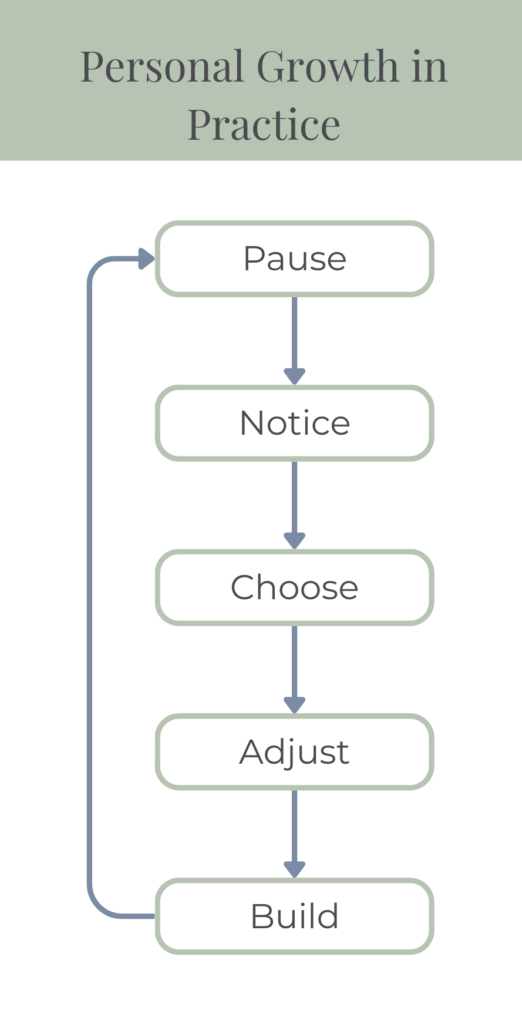
Personal growth doesn’t require dramatic transformation. It shows up in ordinary moments, such as:
- pausing before reacting and choosing a steadier response
- noticing patterns that drain your energy and adjusting them gently
- reflecting on challenges instead of judging yourself for them
- building confidence in your ability to adapt as life changes
Over time, these small shifts add up — not by forcing change, but by increasing your capacity to meet your life as it is.
Why Personal Growth Matters When Life Feels Full
When life feels crowded, growth often gets framed as “one more thing to work on.”
That framing misses the point.
Personal growth matters because it helps you:
- understand your patterns instead of fighting them
- respond more thoughtfully under pressure
- build confidence in your ability to adapt
- recover more quickly when things feel off track
- make changes without starting over
Growth doesn’t require dramatic shifts. It happens through reflection, awareness, and small course corrections — especially during busy seasons.
Why is Personal Growth a Core Area in the Intention-Based Living Method™
The Intention-Based Living Method™ is designed to help you create space, shape your days, and build a life that feels manageable and meaningful. Personal growth supports each of these stages by strengthening how you relate to yourself along the way.
Without personal growth, structure alone isn’t enough.
You can plan your days and set clear intentions, but if you don’t understand your patterns, reactions, and internal signals, those structures eventually feel rigid or draining.
Personal growth builds the inner capacity that makes the method sustainable. It helps you:
- notice what’s shaping your choices beneath the surface
- respond more steadily instead of reacting automatically
- adapt your intentions as your life and responsibilities change
Within the method:
- In Create Space, personal growth helps you recognize what’s draining you and what you need more of right now.
- In Shape Your Days, personal growth works in the background — supporting planning and habit-building by helping you understand what makes consistency easier or harder for you.
- In Build Your Bigger Life, it strengthens resilience, confidence, and trust in your ability to follow long-term direction.
Rather than pushing change, personal growth helps you stay connected to yourself as change happens.
That’s why it’s a core area — not as a separate self-improvement track, but as the foundation that allows intentional living to work in real life.
What Personal Growth Looks Like in Everyday Life
Personal growth shows up in daily life through small, ordinary choices rather than dramatic changes. It shows up in how you respond to ordinary moments.
For example:
- pausing before reacting to stress and choosing a calmer response
- noticing a habit that isn’t serving you and adjusting it slightly
- reflecting on a challenging day instead of judging it
- recognizing patterns in how you overextend or pull back
- giving yourself permission to grow at your own pace
These moments may seem small, but they build resilience and clarity over time.
What Personal Growth Helps You Build Over Time
With steady personal growth, you may begin to notice:
- greater self-trust in your decisions
- increased emotional steadiness
- clearer boundaries around your energy
- more patience with yourself during change
- confidence that growth doesn’t require urgency
Personal growth isn’t linear. Some seasons are about learning. Others are about integrating. Both count.

Tools That Support Personal Growth
Personal growth doesn’t require constant effort or dramatic change.
The tools below are designed to help you build awareness gradually — so growth happens through understanding, not pressure.
These tools are meant to be used alongside real life, in moments that already exist.
Reflection Prompts (Free)
A simple set of prompts designed to help you pause, notice patterns, and reflect without overthinking.
These prompts support personal growth by helping you:
- become more aware of how you’re responding to everyday situations
- notice what’s supporting you — and what’s quietly draining you
- build clarity without needing to “fix” anything
They’re especially useful when you want to check in with yourself but don’t have the energy for long journaling sessions.
→ Use the Reflection Prompts
Intention-Based Living Starter Kit (Free)
This free starter kit introduces the core ideas behind the Intention-Based Living Method™ and shows how awareness, intention, and structure work together.
For personal growth, it helps you:
- understand how your patterns shape your choices
- practice responding with more steadiness instead of reacting
- build a foundation for intentional change over time
It’s a supportive starting point if you want more structure without committing to deep or long-term work.
→ Start with the Intention-Based Living Starter Kit
Core Values Toolkit — Guided Workbook (Paid)
This guided workbook is designed for deeper reflection and longer-term clarity.
It supports personal growth by helping you:
- clarify what genuinely matters to you right now
- understand how your values influence decisions and boundaries
- build self-trust as your life and priorities evolve
This tool is best used when you’re ready to slow down and explore what’s guiding your choices beneath the surface.
Explore More: Personal Growth Resource Library
Personal growth can be supported in many ways, depending on your season of life.
You can explore additional tools, prompts, and in-depth articles in the Resource Library — including resources that connect personal growth with intentional living, habits, planning, and long-term direction.
You’ll find:
- guided reflection tools
- practical growth exercises
- longer articles exploring personal growth in real life
FAQ
Personal growth and self-improvement are often used interchangeably, but they reflect different approaches.
Self-improvement typically focuses on fixing perceived flaws or improving performance. It often emphasizes outcomes, discipline, and external benchmarks — doing more, becoming better, or correcting what feels inadequate.
Personal growth, as used here, is more foundational. It focuses on understanding yourself more clearly — how you think, respond, and make decisions — so you can move through life with greater steadiness and self-trust.
Rather than asking, “What should I improve?” personal growth asks, “What’s shaping my responses right now, and what would support me better?”
Growth doesn’t require constant effort or visible progress. Sometimes it looks like learning when to adjust, and sometimes it looks like recognizing what doesn’t need to change. Over time, this awareness builds capacity — making it easier to respond thoughtfully instead of reacting automatically.
Personal growth and intentional living support each other, but they serve different roles.
Intentional living helps you choose how you spend your time, energy, and attention. It brings clarity to what matters and how you want to move through your days.
Personal growth helps you understand why certain choices feel easy or difficult. It builds awareness around patterns, habits, and internal signals that influence your decisions.
When they work together:
- intentional living provides direction and focus
- personal growth provides insight and adaptability
This combination allows you to make choices that fit your real life — not just your plans. As your circumstances change, personal growth helps you adjust your intentions without losing clarity or momentum.
Together, they support sustainable change: decisions that feel grounded, flexible, and aligned over time rather than rigid or forced.
No. Personal growth does not require dramatic changes, constant effort, or reinventing your life.
In fact, growth often works best when it’s small and steady.
Personal growth begins with noticing — how you respond to situations, where tension shows up, what supports you, and what drains you. These observations create space for gentle adjustments, not pressure to overhaul everything at once.
Especially when life already feels full, growth can look like:
- pausing before reacting
- reflecting instead of judging
- making one small adjustment instead of many
- choosing rest or stability when needed
Growth happens in cycles. Some seasons are about awareness and learning; others are about applying what you’ve learned or simply maintaining what works.
You don’t need to be “working on yourself” all the time to grow. Personal growth continues as you build capacity, trust yourself more, and respond to life with greater clarity — even during quieter or slower seasons.